
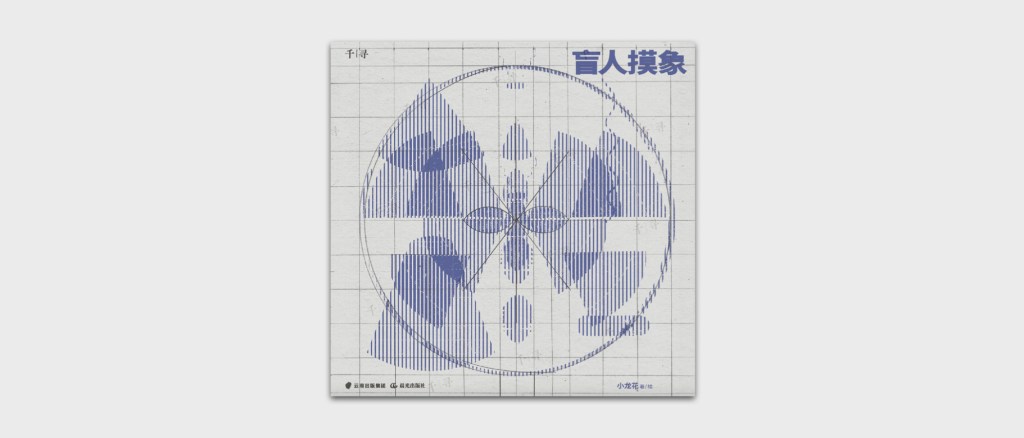
Original Title
盲人摸象

Author
Xiao Long Hua

Language
Chinese/English

Pages
48

Published
Neverend/Yuchen Culture
March 2022
“If the doors of perception were cleansed, everything would appear to man as it is, infinite. For man has closed himself up, till he sees all things thro' narrow chinks of his cavern. “
— William Blake

A New Interpretation of the Classic Story "The Blind Men and the Elephant".

The popular version of "The Blind Men and the Elephant" uses four examples of the blind man touching the elephant to demonstrate that we cannot look at things from a biased perspective. However, Xiao Long Hua discovered that in other versions of "The Blind Men and the Elephant," there is a Buddha "King Mirror" who can penetrate the surface and gain omniscience. On this basis, he constructed the "Mirror Kingdom" where the story took place, and with a unique visual image and artistic language, he combined "The Blind Men and the Elephant" with the legend described in the ancient Miao song "Mother Butterfly" to retell a new story on endless knowledge and exploration.

Xiao Long Hua uses engineering blue paper as the background in this work to deconstruct the form of the object into a figure, so that the "image" becomes a "phase." Graphics have been stitched together. In this case, he uses "splicing" of graphics to reflect the story's fluidity, and four different graphics to express the elephants perceived by the four blind men. The story continued to change like a kaleidoscope after the King Mirror received four answers, which conveys that everyone gets a limited answer through his own path, but even with this limited answer, there are infinite possibilities.

About the Author
Xiao Long Hua is an artist based in Shanghai. His creation involves paintings, installations, comics, and sculptures. He excels at breaking down material constraints and creating new possibilities in space.
艺术家小龙花融合苗族古歌《蝴蝶妈妈》所述传说,重述经典故事《盲人摸象》。 从此,一头笨重的大象幻化为一只轻盈的蝴蝶,继而衍生出万物,变化万千,无穷无尽。
🐘若感知之门豁然,则求知之门无尽——全新诠释的经典故事
普及版的《盲人摸象》用四个盲人摸象的例子告诉我们,看待事物不能以偏概全。 但小龙花发现,在《盲人摸象》的其他版本中,还有一个能够参透表像获得全知的佛陀“镜面王”。在此基础上,他又构筑了故事的发生地“镜面国”,并以独特的视觉形象和艺术语言,将《盲人摸象》与苗族古歌《蝴蝶妈妈》所述传说相融合,重新讲述了一个有关于求知无限、探寻无尽的“盲人摸象”故事。
🐘抽象的“镜面国”世界,幽蓝之中显现一个更艺术、更颠覆、更深刻的“摸象”故事
在这次以“盲人摸象”为题的命题创作中,小龙花以工程蓝纸为背景,将物体形态解构为图形,使“象”成为“相”,最终呈现的一个个画面犹如由更复杂的七巧板图形拼接而成。 在这里,他使用图形的“拼接”以体现故事发生的流动性,并分别用四个不同的图形来表达四个盲人所感知到的大象。 镜面王获得四个答案后,故事并没有停下,而是如万花筒般不断发生变化,无穷无尽。 意指“每个人通过自己的路径得到了有限的答案,但即使这有限的答案,也有无限的可能。 ”
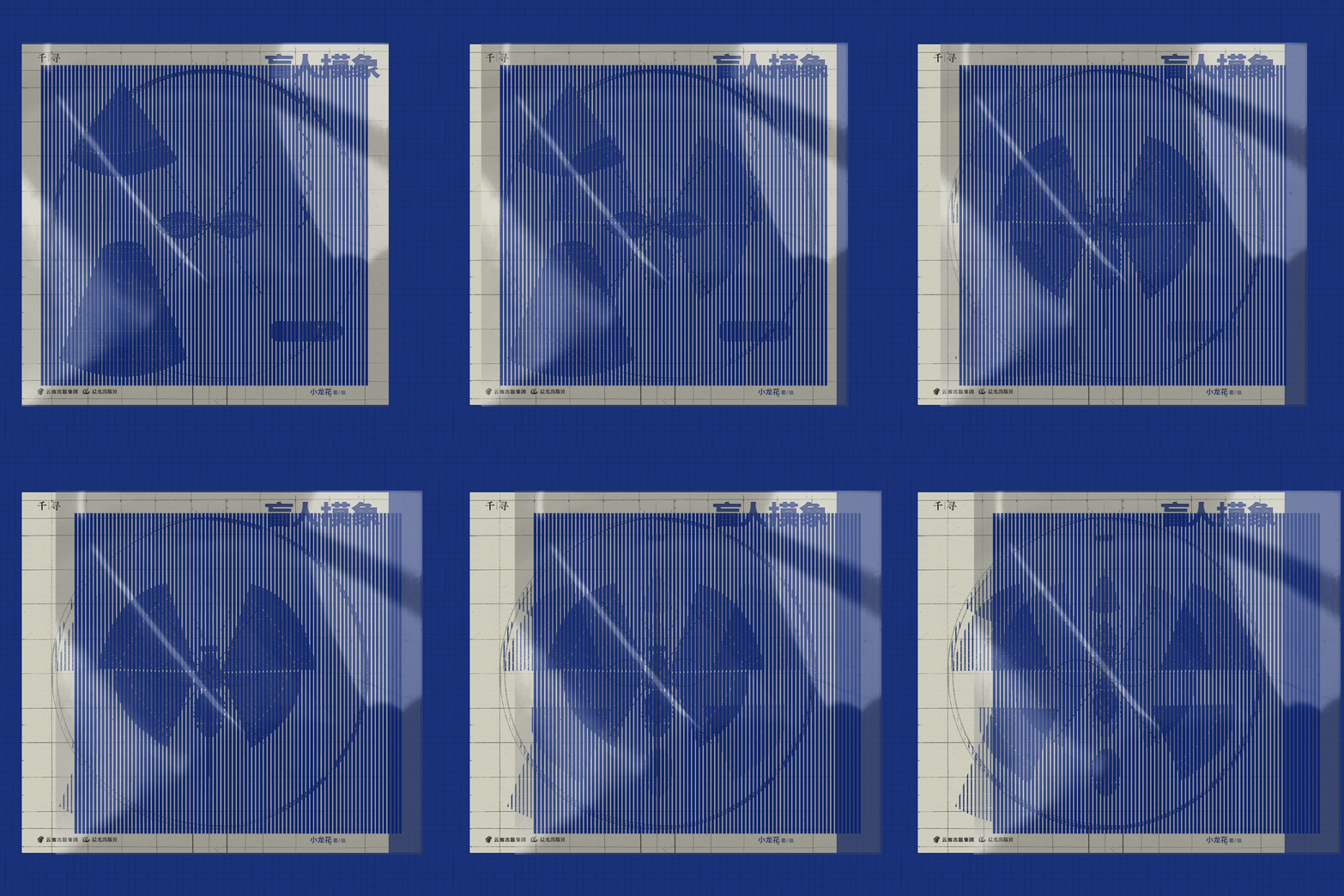
🐘”栅格“封面设计,以流动的方式打开书本
此版《盲人摸象》继续由设计师吕旻操刀,在装帧设计上与上一版做出区别,通过另一种打开书本的方式,呈现万物流动、幻化万千的样态,呼应本书所提出的“殊途同归,最终都可以逐渐接近这个世界的真相。 ”
🐘追加作者后记,讲述作品诞生历程
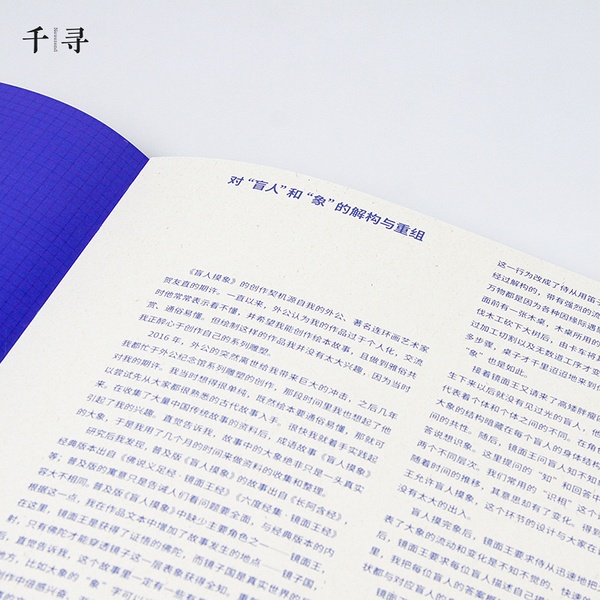
该版《盲人摸象》附加了作者小龙花的后记。 在后记中,小龙花讲述在其外公、著名连环画家贺友直的影响下,自己开始绘本创作后的点点滴滴,并阐述这本书的选题缘起和创作思路。
小龙花
原名薛颖峰,工作生活于上海的艺术家。创作涉及绘画、装置、漫画、雕塑,擅长打破材料的原始束缚,在空间中构建新的可能代表作品:《盲人摸象》《大迁徙》等。
千寻Neverend
一个认真做书的文化出版品牌,关心儿童地位,专注美与思考,宣导终身学习。 在文学、教育、艺术等多方面陪伴爱学习的人一起成长,从不一样的角度深读自我、周遭和世界。其他出版作品有:《寻谣记》《中国故事·全三卷》
 jadeliteraryagency.com